
Donaldson Dust Collectors: Selecting the Right Industrial Air Filtration System

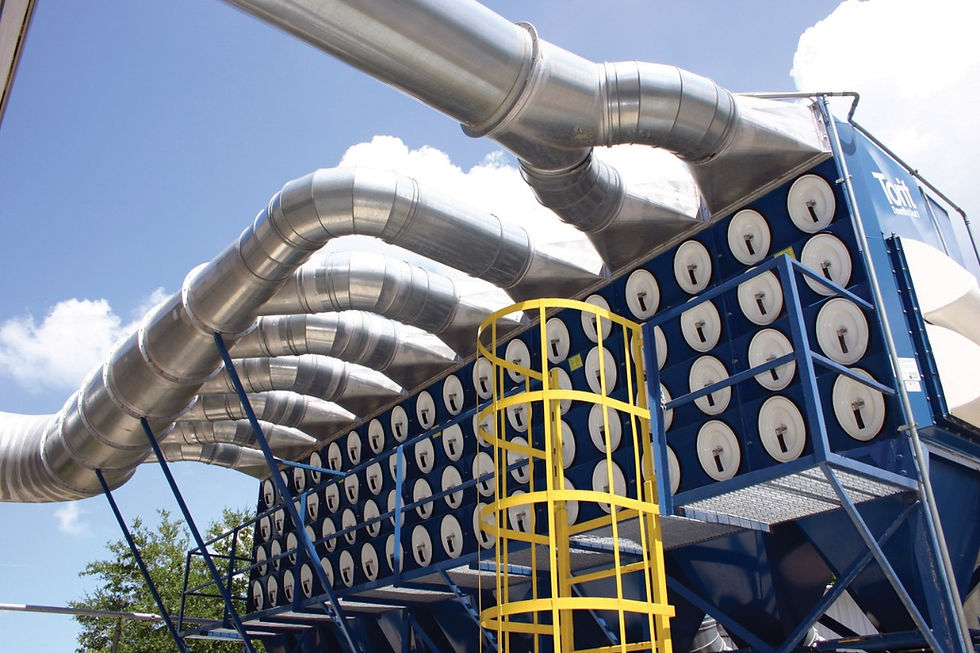
Dust is more than a housekeeping concern. In an industrial facility, uncontrolled particulate can affect employee exposure, product quality, equipment reliability, plant cleanliness, regulatory compliance, and, in some applications, fire and explosion risk.
A properly designed dust collection system captures airborne particulate as close as practical to the point of generation, transports it through properly sized ductwork, separates it from the airstream, and safely contains or discharges the collected material. Donaldson offers cartridge collectors, baghouses, compact PowerCore systems, cyclone separators, shaker collectors, bin vents, downdraft benches, and other configurations for processes ranging from intermittent workstations to continuous, high-volume production.
The challenge is not simply selecting a collector with enough airflow. The system must be matched to the dust, process, operating schedule, facility layout, safety requirements, and maintenance capabilities.
Why Industrial Dust Collection Matters
An effective dust collection system can provide several important operational benefits.
Supporting a Cleaner, Safer Workplace
Capturing dust before it disperses through the building can help reduce airborne particulate and limit accumulation on floors, structural members, electrical equipment, lighting, and production machinery. This supports improved housekeeping and helps facilities manage occupational exposure concerns.
Dust collection is especially important when processes generate very fine particles. These particles may remain airborne longer than heavier material and may travel beyond the immediate process area before settling.
Protecting Production Equipment
Dust can enter motors, bearings, control cabinets, sensors, combustion equipment, and finished-product areas. Over time, contamination may contribute to overheating, premature wear, instrumentation problems, product defects, and unplanned downtime.
Source capture helps prevent particulate from becoming a plant-wide maintenance issue.
Managing Combustible-Dust Hazards
Many materials that do not appear hazardous in bulk form can become combustible when reduced to fine particles. Examples may include wood, food ingredients, plastics, chemicals, certain metals, and other organic materials.
Current combustible-dust planning should account for NFPA 660, published in December 2024, which consolidated several previous combustible-dust standards into a common framework. Facilities handling potentially combustible particulate should begin with representative dust testing and a documented Dust Hazard Analysis, or DHA. Collector location, explosion venting, isolation, suppression, ignition control, and safe discharge arrangements must then be selected as part of the facility’s overall protection strategy.
A dust collector is an important component of combustible-dust management, but it is not, by itself, a complete fire or explosion protection solution.
Understanding Donaldson’s Dust Collector Options
1. Downflo Evolution Cartridge Collectors
The Donaldson Torit Downflo Evolution, or DFE, is a pulse-cleaned cartridge collector designed for demanding industrial dust and fume applications. It is commonly considered for metal fabrication, welding and thermal cutting, abrasive blasting, dry material processing, pharmaceutical production, composites, and other processes that generate fine, dry particulate.
The DFE directs incoming air toward a dropout zone, helping heavier material move toward the hopper before reaching the filters. Its MaxPulse cleaning system is designed to deliver 27% more cleaning energy to the filter media. Donaldson states that the system can reduce the required number of filters and collector size by up to 40% compared with a typical cartridge collector.
Standard Ultra-Web fine-fiber media uses an electrospun layer with fibers approximately 0.2 to 0.3 micron in diameter. The media is designed to capture fine particulate at the surface instead of allowing it to penetrate deeply into the substrate. This surface-loading behavior can improve pulse-cleaning performance, control pressure drop, and extend filter service life. Ultra-Web options include MERV 14 and MERV 15 configurations for appropriate applications.
Best suited for:
Fine, dry, nonfibrous dust
Continuous-duty production
Applications requiring a compact footprint
Centralized collection systems with multiple pickup points
Processes where pulse cleaning can occur during operation
Important considerations:
Compressed-air quality and availability
Dust moisture and agglomeration characteristics
Abrasiveness and particle loading
Cartridge media compatibility
Hopper and discharge-device selection
Combustible-dust protection requirements
2. PowerCore CP Series
PowerCore collectors are designed to provide baghouse-style performance in a substantially smaller package. The technology uses compact, fluted filter packs with Ultra-Web media instead of traditional cylindrical cartridges or long filter bags.
Two primary configurations are available:
CPC stand-alone collectors: Designed for ducted industrial applications, with published airflow capacities from approximately 700 to 33,000 cfm.
CPV bin vents: Designed for silos, mixers, blenders, transfer points, and conveyor discharges, with published airflow capacities from approximately 450 to 8,200 cfm.
Donaldson reports that CPC collectors can be up to 50% smaller than comparable traditional baghouses, while CPV bin vents can be nearly 70% shorter than traditional bag-style bin vents.
Best suited for:
Facilities with limited floor space or headroom
High dust-loading applications
Pneumatic conveying and bulk material handling
Silo and bin ventilation
Applications where clean-side filter access is preferred
Plants seeking faster filter replacement and reduced confined-space exposure
Because PowerCore filter packs are smaller and lighter than many conventional bags, filter changes can be completed without filter cages and, in many arrangements, without entering the dirty-air section of the collector.
3. Baghouse Dust Collectors
Baghouses remain a strong choice for high dust volumes, fibrous material, abrasive particulate, and continuous industrial processes. Donaldson baghouse systems use from approximately 6 to 900 felt bags, depending on the collector and application. Dust generally collects on the outside of the bags while filtered air passes through the media and exits the collector.
Donaldson’s baghouse offering includes the RF Series, Dalamatic, LP Series, Unimaster, Modular Baghouse, IRD Series, Cabinet Series, and other specialized configurations.
The RF Series combines cyclonic pre-separation and bag filtration in one unit. Its inlet gives the airstream a cyclonic motion, allowing heavier material to drop out before reaching the filter bags. The RF cleaning system does not require compressed air, which may simplify utilities and reduce compressed-air consumption.
Dura-Life bag media uses a hydroentanglement manufacturing process that creates more uniform pore spacing than conventional needled polyester. This supports surface loading, cleaning performance, lower differential pressure, and extended filter life. Donaldson reports that Dura-Life bags can provide up to twice the operating life of standard 16-ounce polyester bags in applicable conditions.
Best suited for:
High dust concentrations
Heavy or abrasive particulate
Fibrous or irregularly shaped material
Large centralized systems
Continuous bulk processing
Woodworking, agriculture, mining, food processing, and material handling
Important considerations:
Bag material and temperature rating
Moisture and condensation
Cleaning method
Air-to-cloth ratio
Inlet abrasion protection
Hopper slope and evacuation equipment
Service access and bag-replacement procedures
4. Cyclone Separators
A cyclone uses centrifugal force rather than primary filter media to separate heavier particulate from an airstream. Dust-laden air enters tangentially, creating a spinning motion. Heavier particles move toward the outer wall and fall into the hopper, while the air exits through the center.
Donaldson cyclones are intended for high dust loads, elevated-temperature applications, and product-recovery processes. Published airflow ranges extend from approximately 300 to 13,000 cfm, depending on cyclone size. They can be used alone, equipped with an optional bag-filter assembly, or installed as a pre-cleaner ahead of a cartridge collector or baghouse.
Best suited for:
Coarse, dense particulate
High inlet dust concentrations
Product recovery
High-temperature processes
Pre-separation ahead of final filtration
A cyclone is generally less effective on very fine or low-density particulate than a cartridge collector or baghouse. Its efficiency is affected by particle size, particle density, shape, inlet velocity, airflow, and dust concentration. When fine-particle emissions must be controlled, secondary filtration is often required.
5. Vibra Shake Collectors
Vibra Shake collectors are compact, self-contained cartridge systems intended primarily for intermittent-duty operations. When the blower shuts off, a mechanical vibration system cleans the filter. Because cleaning occurs during shutdown, these collectors do not require compressed air.
Published models provide nominal airflow capacities from approximately 550 to 3,000 cfm, with filter areas ranging from approximately 65 to 354 square feet.
Depending on the model, fan motors range from approximately 3 to 7.5 horsepower.
Best suited for:
Intermittent operations
Small production areas
Precious-metal recovery
Work cells and educational shops
Processes producing a mixture of coarse and fine dust
Facilities without convenient compressed-air access
A Vibra Shake may not be the best selection for a process operating continuously across multiple shifts because the system requires a shutdown period to perform its cleaning cycle.
6. Source-Capture and Ambient Solutions
Not every application requires a large centralized collector. Donaldson also offers downdraft benches, workstations, portable collectors, bin vents, booths, and ambient-air configurations.
A downdraft bench may be appropriate for grinding, sanding, deburring, polishing, or finishing parts at a workstation. A source-capture arm or hood may work better for localized welding or dust generation. Ambient systems can supplement source capture where residual airborne particulate remains, but they should not automatically be treated as a substitute for effective capture at the process.
How to Select the Right Collector
Start With the Dust
The first step is to characterize what the process generates. Important questions include:
Is the particulate coarse, fine, or submicron?
Is it dry, sticky, oily, hygroscopic, or fibrous?
Is it abrasive or corrosive?
What is the temperature of the airstream?
Is there moisture or condensation?
Is the dust toxic, combustible, or explosible?
Should the collected material be recovered or discarded?
A representative laboratory test may be necessary to evaluate combustibility, explosibility, minimum ignition energy, Kst, Pmax, and other characteristics needed for hazard analysis and equipment design.
Calculate the Required Airflow
Collector airflow should be based on the requirements of each pickup point, not on a rough estimate of the room’s size. The system designer must evaluate hood geometry, capture velocity, conveying velocity, duct diameter, the number of simultaneous pickup points, and total system static pressure.
The airflow requirements from active hoods are combined to establish the collector capacity. The fan must then deliver that airflow while overcoming losses through hoods, ducts, fittings, dampers, filters, and the collector itself.
An oversized fan can waste energy, pull unwanted product into the system, accelerate duct wear, and overload filters. An undersized fan may fail to capture or transport the dust.
Evaluate Air-to-Media Ratio
Air-to-media ratio compares airflow with available filter area. It influences pressure drop, cleaning frequency, filter loading, emissions, and service life.
A higher ratio can reduce initial collector size, but it may also increase dust loading and shorten filter life. A lower ratio generally provides more media area but may increase equipment size and capital cost. The correct value depends on dust concentration, particle behavior, media type, cleaning technology, and operating schedule.
Account for Differential Pressure
Differential pressure measures resistance across the filters. A rising pressure differential may indicate dust accumulation, moisture, plugged media, ineffective pulse cleaning, or inappropriate filter selection.
Differential pressure should be monitored and trended. Filters should not be changed simply because they look dirty. A stable dust layer can contribute to filtration efficiency. Replacement decisions should consider pressure drop, airflow performance, emissions, physical condition, process requirements, and the manufacturer’s recommended limits.
Plan for Dust Discharge
The hopper is not intended for long-term dust storage. Collected material must be removed before it bridges, compacts, or reaches the filter section.
Discharge options may include:
Dust drawers or bins
55-gallon drums
Rotary airlocks
Double-dump valves
Screw conveyors
Continuous transfer systems
The correct arrangement depends on the volume, density, flow characteristics, toxicity, and combustibility of the material.
Consider the Total Cost of Ownership
Purchase price is only one part of collector economics. Industrial users should also evaluate:
Fan energy
Compressed-air consumption
Replacement filter cost
Filter-change labor
Production downtime
Dust-disposal labor
Inspection and maintenance access
Heating and cooling losses
Monitoring and controls
Explosion-protection inspection requirements
Advanced media can help reduce operating pressure drop. When combined with a variable-frequency drive and airflow control, lower resistance may allow the fan to maintain the required airflow at a lower speed and power demand.
Final Thoughts
The right dust collector is not necessarily the largest system or the unit with the highest advertised efficiency. It is the collector that matches the physical properties of the dust, captures the required airflow, fits the production schedule, works with the facility’s safety strategy, and can be maintained effectively over its service life.
Donaldson’s broad portfolio gives industrial facilities several practical paths:
Downflo Evolution for compact, continuous-duty cartridge filtration
PowerCore for high performance where space and maintenance access are limited
Baghouses for heavy loading, fibrous material, and large-volume processing
Cyclones for coarse-particle separation and pre-cleaning
Vibra Shake for intermittent-duty applications without compressed air
Downdraft, workstation, bin-vent, and ambient systems for specialized point-of-use requirements
Before final equipment selection, facilities should complete a detailed application review that includes dust characterization, airflow calculations, static-pressure analysis, filter-media selection, combustible-dust evaluation, discharge planning, and maintenance access. A properly engineered system can improve air quality, support compliance, reduce equipment contamination, protect production, and provide a lower total cost of ownership over the life of the collector.


